
Can Danish companies be held liable for future climate-related damage?
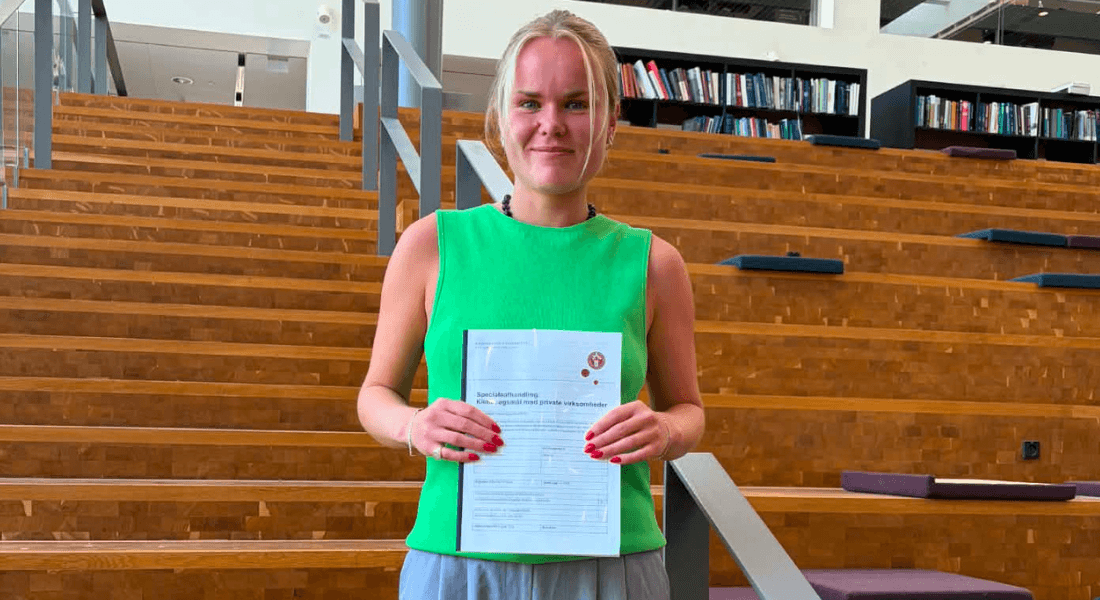
This was the question that the recent law graduate Frida Ræbild Grunnet set out to explore in her master’s thesis. Inspired by a prominent German climate case, she examined whether companies in Denmark could be required to pay to contribute to the costs of preventing climate-related damage to which their greenhouse gas emissions contribute.
Frida’s research took her across a range of legal disciplines and into a field where climate change tests the limits of existing legal frameworks and where many questions remain unresolved.
An Open Question in Danish Law
The inspiration for Frida’s thesis came from a German climate case in which a Peruvian farmer sought to hold a German energy company liable for climate change impacts threatening his property. Although the claim was ultimately dismissed in 2025, the judgment suggested that climate-related compensation claims may be legally viable under certain circumstances.
This sparked Frida’s interest in whether Danish law contains legal mechanisms that could support climate-related compensation claims against Danish companies with significant CO₂ emissions. Her analysis shows that Danish law does not contain a direct legal basis corresponding to that relied upon in the German case.
Climate Change Challenges Traditional Legal Boundaries
Frida’s interest in climate and sustainability accompanied her throughout her studies. During an exchange stay in Singapore, she took a course in international environmental law, and when she was introduced to the German case during a course offered by the think tank Justitia, she saw an opportunity to explore an issue that had not yet been examined in a Danish context.
It quickly became clear that the question could not be answered within a single area of law.
“I initially thought I was going to write a thesis in tort law. But suddenly I found myself dealing with issues related to nuisance law , environmental law, property law and a number of other areas. I was surprised by how many places I had to look.”
Her analysis clearly demonstrates how climate change challenges traditional legal categories and requires lawyers to think across disciplinary boundaries.
Working in a Legal Field Without Clear Answers
The lack of clear rules and previous research proved to be both the greatest challenge and one of the most rewarding aspects of the thesis process. Frida had to work with legal sources that were never drafted with climate change in mind.
“There is no dedicated law on compensation for climate-related damage that you can simply look up. I had to investigate whether existing rules could be interpreted in new ways.
The interdisciplinary nature of the work taught her how to deal with complex legal questions and draw her own conclusions.
“It has been incredibly motivating to work on my own project and create something myself. It was also a fitting way to conclude my studies by defending something that reflected my own words and my own conclusions. It has been challenging, but also incredibly exciting.”
Although Frida does not yet know exactly which direction her career will take, the thesis has strengthened her interest in sustainability-related issues. At the same time, the project has shown her that sustainability will be relevant regardless of where she ends up. The green transition already affects, or will eventually affect, virtually every area of legislation and legal practice.
If you would like to learn more about Frida’s analysis and conclusions, you can read the full thesis (in Danish) here.